Tuesday, August 14, 2007

Dr Fungus

I know that there are probably more than a few of you who are, or intend to be, pre-med. For your interest and edification I direct you to Dr Fungus - an independent Web site dedicated to providing a wide range of scholarly peer-reviewed contemporary and historical information regarding fungi.

'We seek to promote an understanding of fungi and the ways that fungal diseases of humans, animals, and plants affect people living throughout the world. We provide information to both professionals and the public by making a broad range of mycology-related images and content instantly available via the World Wide Web.'

You can attempt a diagnosis of your fungal infection, read about sick building syndrome, learn about anti-fungal agents and check out their image library.

This time last year: Humongous Fungus
Also check out Campbell 7th, and As requested which are still relevant and, hopefully useful.

Labels: ,

Monday, August 06, 2007

Frog-killing fungus

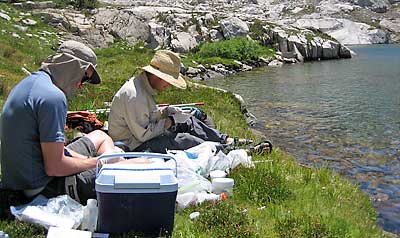
When we get to our fungi lecture I won't have more than a few minutes to talk about a strange group of fungi the Chitridiomycota - or the Chytrid fungi. Not included in the Fungi group until recently they are mostly detritivores, living on dead material, but at least one species is pathogenic. The waterborne fungus, Batrachochytrium dendrobatidis, attacks many species of amphibians and is at least partially responsible for a global decline of amphibians.

Work carried out at UC Berkeley and published in PNAS next week now suggests that the fungus may end up playing the bigger role in the frog's demise than previously thought because of the pathogen's ability to spread over long distances and possibly persist in the environment as a consequence of sexual reproduction. A study of the genetics of the fungus provided the first evidence of genetic recombination in B. dendrobatidis, which results in multiple, related genotypes and suggests that sexual reproduction is occurring - even though spores have not been discovered.

This work was carried out in the Briggs lab in Integrative Biology in association with the Taylor lab in Plant and Microbial Biology and is part of a larger project on chytridiomycosis (the disease caused by B. dendrobatidis) and the mountain yellow-legged frog led by Cheryl Briggs, UC Berkeley associate professor of integrative biology.

This time last year: CNR Smorgasbord

Labels: , , ,

Tuesday, August 15, 2006

Humongous Fungus

If you'd like to read a little more about the original humongous fungus there's a really interesting article by Tom Volk, first published in Inoculum in 2002, a decade after the discovery of the fungus. You can read the article online here. The fungus they discovered, an individual Armillaria bulbosa, aka the honey mushroom, was conservatively estimated to be at least 1500 years old and weigh around 100 tons - making it one of the largest and oldest living organisms.

I learned lots of fascinating trivia from this article:

The project was actually an offshoot of a grant from the Department of Defense, which funded a project to study the possible biological effects of ELF (Extra Low Frequency) stations in the Upper Peninsula of Michigan. These ELF stations were built to communicate underground with ocean-going submarines in time of war.

They sampled for the fungus by 'baiting' with tongue depressors. The fungal mycelium quickly colonized the wood sticks.

They were not looking for a large fungus, or even trying to measure the size of any fungus. The project was originally to look at how mitochondrial DNA was inherited in fungi in nature.

When news of the 'giant fungus' broke in the press CNN wanted someone to go out into the woods and wave from the fungus so they could get an aerial picture of the humongous fungus.

Even better, a Japanese businessman called and wanted to build a boardwalk around the humongous fungus and charge people to view the 'pulsating mass of fungus'.

Labels: